 Image 1 of 1
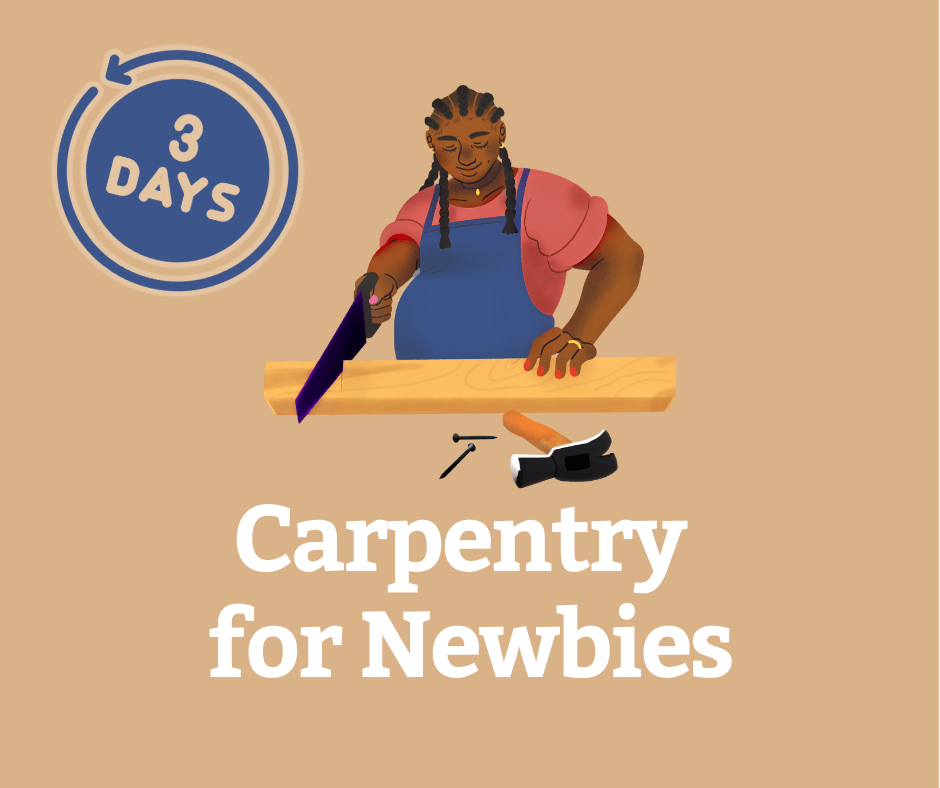
Carpentry for Newbies
3-Day Workshop Sept 11-13, 2026
Introduction to carpentry tools, skills, and materials. Ideal for folks who have always wanted to learn basic carpentry skills.
This workshop is for all the folks who have no (or very little) carpentry experience but want to learn basic carpentry. Through doing actual building projects each day, participants will gain skills and confidence to tackle basic carpentry projects on their own. This workshop is a safe place to be a learner because everyone taking this workshop is a beginner at carpentry. Scroll down for a breakdown of what will be covered in the workshop.
-
8:30am Site Open
9am-noon Morning Session
noon-1pm Break for lunch. Participants bring their own lunch
1-4pm Afternoon Session
-
Topics:
Intro to Rough Carpentry: What does carpentry involve. Primarily it involves working with wood, but also other materials, especially materials that are often joined to wood (e.g. metal, sheetrock, composite materials, etc.) to make functional items.
All about wood. Types of wood. Standard dimensions. Wood Grain.
Using Hand Tools
Plumb, Level, Square
Measuring (Measure twice, cut once) and Marking
Cutting, notching, drilling, shaping wood
Types of Carpentry: Rough Carpentry, Finish or Trim Carpentry, Cabinet making/Furniture Making
Connecting wood: Nails. Screws. Bolts, Joinery. Glues and adhesives
Basic Powertools (Circular Saw, Power Miter Saw, Electric Drill and driver)
Electric Tools vs. Battery Powered Tools vs. Hand Tools
Carpentry Safety
Project: Build Sawhorses
Skills involved:
Measuring
Cutting
Drilling
Nailing
Screwing wood together
Working with lumber
Efficient use of lumber
Building from an existing pattern
-
Topics:
Basic Finish Carpentry
Joining wood together
Ways to minimize wood splitting or splintering
Sanding
Finishes: Paint, oils, stains, natural finishes, etc.
Wood Grain and how to work with the grain
Ripping vs. Cross cutting
Tools for shaping wood: chisels, planes, routers, etc.
Methods for holding wood while working with it: Vices, clamps, tape
Different types of wood and what type to use where. Why you might choose different wood species for different projects. Soft woods. Hard woods, etc.
Buying wood. Recycled wood. Making your own lumber.
Engineered wood: Plywood, OSB, MDF, particle board, LVLs etc.
Efficient work spaces (Work table, saw horses, lighting, ventilation, etc.)
More advanced power tools: Table saw, Router, Planer, etc.
Safety while working
Cutting larger sheets of material (plywood, luan, OSB)
Use of Chalk line
Connecting dissimilar materials together
Working alone. Working with a partner/helper
Project: Make a bookshelf
Skills involved:
Accurate measuring and cutting.
Cutting at angles.
Shaping wood.
Wood finishing.
Finish Nailing.
Glueing.
Tools for holding wood.
Squaring.
Use of plywood backing.
Reading construction drawings.
Making changes to construction drawings.
Drilling.
Adjusting based on materials available.
Substitutions.
-
Topics:
Building Structures (e.g. Shed, wood storage area, covered space, deck, house, etc.)
Protecting wood from the elements
Basic parts of a structure: footing, foundation, floor system, walls, roof, etc.
Making Patterns
Intro to Building Codes and Zoning laws
Nailing (or screwing) requirements
Laying out a larger project
Ways to increase work efficiencies
Repair work (Tools for removing wood: pry bars, saws, specialty tools)
Maintenance
Remodeling
Project: Build a Deck
Skills involved:
Layout
Building Codes
Reading construction plans
Cutting lumber
Working with Pressure Treated Lumber
Working with connectors (nails, screws, bolts, joist hangers, etc.)
Hammering
Drilling
Screwing
Footings
Posts
Floor System
-
Safety Glasses
Hammer
Tape Measure (at least 20’ tape measure)
Speed Square
Carpenter pencil
Utility Knife
Chisel (¾” or 1” wide) (Optional)
Small pry bar (Optional)
6 in 1 screwdriver (Optional)
Dust Mask (Optional)
Tool Belt (Optional)
Construction Gloves (Optional)
Ear Protection (Optional)
-
Workshop happens regardless of weather. If it is raining, we will do inside work or activities. If weather is very warm, we will do the more physical parts of the workshop in the mornings when it is cooler, so the schedule each day will remain flexible to adjust to weather conditions.
Overnight Camping available at $10/night
Basic hand tools required by each participant (See list provided with the course outline)
The workshops cover knowledge and hands-on experience.
Number of Participants capped at 12.
This workshop is not eligible for use with a season pass.
Youth, under 18, may notattend free with an adult. Instead, they should be registered independently.
-
Deep River Folk School Carpentry and Woodworking Workshops
Other Folk Schools or Education Programming: Greenwood Wrights’Fest, Piedmont Earthskills Gathering, Holistic Survival School, Wild Abundance
Books (See book table during workshop)
YouTube Videos (quality is quite variable)
Construction Shows (e.g. “This Old House”)
Community College Classes (Quality varies)
Carpentry Groups or Clubs
Mentors or Skilled Friends and Acquaintances
Volunteering (e.g. Habitat for Humanity)
Doing Projects and Learning by Doing
Doing Construction or Carpentry work for pay (work experience)
-
If you need to make incremental payments, we can coordinate that with you. Please email Morgan at deepriverfolkschool@gmail.com to request a partial payment schedule.
We are limited in our ability to offer work-trade and scholarship for this program, but please email Harvey if you would like to pursue that possibility. harvey.harman@gmail.com

Lead Instructor: Harvey Harman
Harvey is a green builder, licensed General Contractor, licensed plumber, conservation-oriented land developer, organic farmer, teacher, and writer. Harvey is influenced by his experiences of living in various community settings, including a remote retreat center in the cascade mountains in Washington state, and five years in a traditional, rural village in Southern Africa. Harvey initiated and helped develop the Sustainable Farming Program at Central Carolina Community College (CCCC) in Pittsboro, NC, and has taught many classes at CCCC in the past 25 years in Sustainable Agriculture, Permaculture, Green Building, and Construction/Plumbing. Harvey was the Carolina Farm Stewardship Association Farmer of the Year in 1998. Harvey has been a Building Contractor for the past 25 years and was the Construction Director for Chatham Habitat for Humanity for 13 years.
Harvey is also a cofounder of Living Well Ecovillage and is passionate about building resilient and sustainable networks of people and communities. In his spare time Harvey loves to design and build small and tiny houses and share information and practical skills with others.